
Crafting photorealistic art involves a meticulous understanding and precise manipulation of light, materials, and composition to create images that closely replicate the intricate interactions encountered in the real world.
Advanced rendering engines like V-Ray and Corona Renderer simulate global illumination and physical camera parameters for lifelike results.
AI tools like RunwayML empower artists to generate photorealistic images from textual descriptions, democratizing the creative process.
By harnessing these cutting-edge techniques, artists create visually stunning and emotionally resonant works that push the boundaries of photorealism.
Table of Contents Toggle
- Key Takeaways
- Understanding Photorealistic Theory
- Advanced Image Creation Techniques
- AI Tools for Photorealism
- Enhancing Visual Fidelity
- Collaborative AI Artistry
- Frequently Asked Questions
- What Is the Ideal Hardware for Creating High-Performance Photorealistic Renderings?
- How Do I Choose the Most Effective AI Tools for My Specific Project Needs?
- What Are the Key Differences Between Photo-Realistic Rendering and Realistic 3D Models?
- Can I Use Ai-Generated Assets for Commercial Use Without Licensing Issues?
- What Are Some Common Pitfalls to Avoid in Post-Processing 3D Images for Photorealism?
Key Takeaways
Crafting Photorealistic Art Using Material Modeling, AI Elements, and Precision Editing
Crafting photorealistic art combines detailed material modeling, merging AI-generated elements with artist style, precise editing techniques, and leveraging real-time feedback.
Understanding Photorealistic Theory
Understanding Photorealistic Theory
Key Principles of Photorealistic Rendering
Photorealistic theory centers around accurately replicating the intricate interactions between light and materials encountered in the real world.
This replicative process defines photorealistic rendering, the art of creating digital images that capture reality with high realism.
Attention to Lighting and Materials
Mastering photorealistic rendering demands utmost attention to detail and the precise manipulation of light and materials.
The dance of light and shadow must be meticulously balanced to create visual appeal.
Composition and Emotional Connections
Effective rendering requires an in-depth understanding of lighting, materials, and compositional techniques, which lead to the final, mesmerizing image that truly captures reality.
High-quality photorealistic rendering goes beyond technical proficiency, delving into emotional and psychological connections that create lasting impressions on the viewer.
Advanced Image Creation Techniques
Transforming raw ideas into stunning visuals using immersive AI tools empowers artists to seamlessly merge their creative style with AI-generated elements.
Midjourney and other advanced AI image generators allow artists to craft photorealistic images with precision, enhancing resolution and detail by adjusting step scales and upscale options.
The application of filters and styles further refines the image, enabling the infusion of artistic flair. Inpainting, image remixing, and other techniques help artists add missing parts and refine details, while scaling and upscale tools help enhance texture and resolution.
Experimentation with styles and emotional resonance empowers artists to refine their artwork and craft unique visual compositions.
These advanced image creation techniques integrate seamlessly with technologies like 3D modeling and animation, enhancing the development of interactive and immersive experiences, including augmented and virtual reality, thereby pushing the boundaries of photorealistic art.
AI Tools for Photorealism
AI Tools for Photorealism offer remarkable capabilities to create photorealistic images.
AI-powered rendering engines like Corona Renderer simulate real-world lighting and materials with accuracy, generating lifelike images.
Real-time Rendering Capabilities
Real-time rendering tools like Lumion and Blender Cycles provide artists with instant feedback, allowing them to iterate and adjust compositions efficiently.
AI-Driven Generative Art
AI-driven generative art tools leverage GANs to create surreal and photorealistic artworks inspired by renowned painters.
Tools like DALL-E and Prisma empower artists to generate photorealistic images from textual descriptions, streamlining creative workflows and increasing efficiency in photorealistic rendering.
Enhancing Visual Fidelity
Enhancing visual fidelity in photorealistic art requires meticulous attention to various techniques designed to replicate real-world intricacies.
Advanced rendering engines, such as V-Ray and Corona Renderer, play significant roles by providing features like global illumination and physical camera models. These engines simulate real-world light behavior and camera interactions, heightening realism.
Paying attention to surface imperfections, ubiquitous in real-world objects and surfaces, further enhances realism. Reference images confirm accuracy, while experimenting with materials and textures helps create convincingly realistic appearances.
A strong art direction combined with high-graphical fidelity supports a more memorable visual experience. High-fidelity graphics are important but need not sacrifice artistic expression.
Collaborative AI Artistry
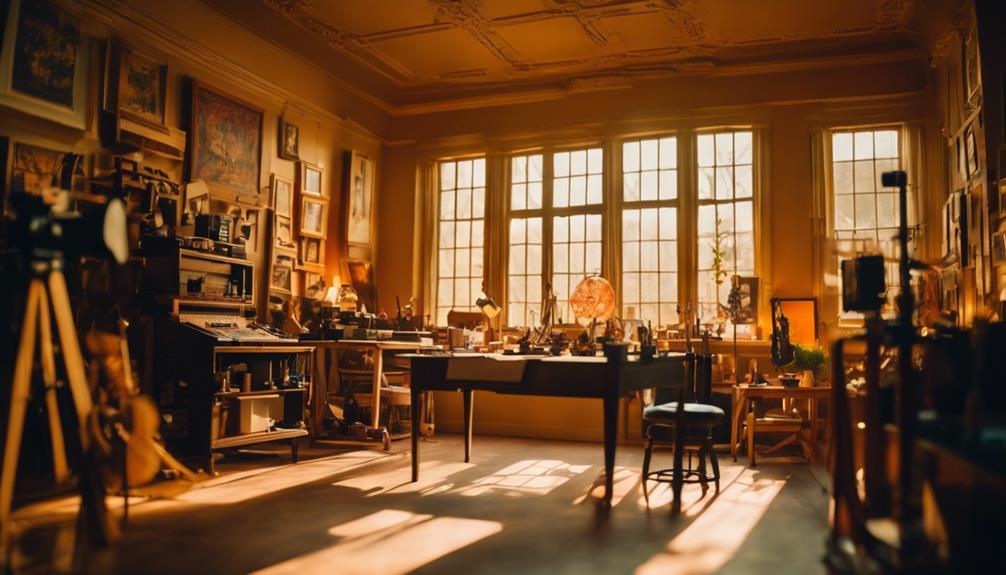
AI-powered platforms, such as RunwayML, Deep Dream Generator, and GAN Paint Studio, are democratizing the creative process.
These tools empower individuals from various backgrounds to harness the power of artificial intelligence for creative expression and innovation,
ensuring that creativity is no longer limited by technical skill or knowledge.
Frequently Asked Questions
What Is the Ideal Hardware for Creating High-Performance Photorealistic Renderings?
For high-performance photorealistic renderings, ideal hardware includes GPU acceleration, high-end graphics cards, extensive RAM, fast storage, and multi-core processors. Key takeaways include:
GPU acceleration for robust graphics performance
Extensive RAM for large file handling and processing
Multi-core processors for efficient handling of complex tasks
How Do I Choose the Most Effective AI Tools for My Specific Project Needs?
To choose the most effective AI tools for your specific project needs:
Match tool features to project goals and budget constraints.
Test tool integrations and assess user reviews for seamless alignment.
Research vendors to find the best fit for your project.
What Are the Key Differences Between Photo-Realistic Rendering and Realistic 3D Models?
Realistic 3D Models focus on detailed surfaces and material properties.
Photorealistic Rendering emphasizes accurate lighting, texture complexity, and atmospheric effects for a lifelike appearance.
The Key Difference lies in how these elements are combined to create a believable visual experience.
Can I Use Ai-Generated Assets for Commercial Use Without Licensing Issues?
To use AI-generated assets commercially without licensing issues:
Understand legal frameworks for AI use in commercial contexts.
Validate asset ownership to avoid copyright attacks.
Consider royalty-free options for long-term financial security.
What Are Some Common Pitfalls to Avoid in Post-Processing 3D Images for Photorealism?
Common pitfalls to avoid in post-processing 3D images for photorealism include:
Overadjusting shadows and highlights that can lead to loss of detail.
Inaccurate color representation and incorrect scaling of objects.
Uneven lighting, noisy textures, and incorrect reflections.