

Photorealistic art emphasizes the intricate interplay between technology and human emotion within the realm of visual representation.
Meticulous details in lighting, shading, materials, and textures present complex technical challenges, necessitating a delicate balance between precision and artistic intent.
In embracing these intricacies and pushing the limits of realism, photorealistic art uncovers profound emotional power and complexity in visual narratives.
Table of Contents Toggle
- Key Takeaways
- What Photorealism Means
- Key Characteristics Explained
- Technical Aspects and Challenges
- Artistic Expression and Freedom
- Industry Applications and Roles
- The Uncanny Valley Effect
- Artistic Preferences and Education
- The Timeless Nature of Art
- Art as Cultural Window
- Emotional Power and Complexity
- Frequently Asked Questions
Key Takeaways
Photorealistic art seeks realism through precise techniques.
Technological complexity demands lighting and material expertise.
Artistic skill balances precision with artist intent.
What Photorealism Means
Photorealism is a distinct art style that endeavors to replicate the exactness and realism through the use of precise techniques and detailed representations that often blur the line between art and reality.
This art movement emerged in the late 1960s, characterized by its relentless pursuit of realism and attention to detail.
Photorealism gains its label due to its inextricable connection to photography.
Artists working within this genre often use photographs as a basis or starting point for their paintings, which can lead to a level of detail and realism that challenges the limitations of art.
This style seeks not only to recreate the tangible aspects of the world but also to capture its inner essence.
Key Characteristics Explained
Key Characteristics of Photorealistic Art Explained
Meticulous Attention and Technical Precision
Photorealistic art is characterized by an unwavering commitment to precision and attention to detail in depicting the mundane and everyday.
Artists frequently rely on photographic references and advanced techniques to blur the boundary between artistic representation and reality.
This pursuit demands high technical skill and scientific knowledge to recreate the complexities of reality accurately, making it a formidable task.
Reproduction of Photographs
Photorealist artists meticulously reproduce the details of photographs using techniques such as airbrushing and layering.
This level of precision requires profound technical skill, as the goal is to deceive the eye into perceiving a painted image as a photograph.
In addition, the use of projection technology allows artists to accurately transfer images onto their canvas, ensuring exactness in the final output.
Challenging Artistic Limits
This level of commitment to realism stems from a fundamental interest in representing the intricacies of life with precision, challenging the limits of what art can achieve.
Photorealism's technical complexities reveal the remarkable fusion of artistry and technical proficiency that underlies these extraordinary lifelike representations.
Technical Aspects and Challenges
Technical Aspects and Challenges
The pursuit of photorealism in art presents a series of complex technical challenges, requiring a deep understanding of lighting, shading, materials, and textures.
Photorealistic art is characterized by its meticulous attention to visual detail, which demands a high level of technical skill and knowledge.
The ability to accurately capture the subtleties of light and shadow, as well as the properties of different materials, is pivotal in creating realistic and immersive experiences.
Physically-Based Rendering
Artist must employ advanced techniques and tools, such as physically-based rendering, to achieve the level of detail and realism required.
Overcoming technical limitations is essential, and artists often need to develop new methods to achieve the desired photorealistic effect.
The relentless pursuit of innovation in software, hardware, and artistic techniques is essential in bridging the gap between the digital and the real world.
Artistic Expression and Freedom
Artistic Expression and Freedom
Photorealistic Art: Balancing Technology and Individuality
Artistic expression relies on the delicate balance between creative freedom and potential restrictions, placing photorealistic art at the crossroads of technological innovation and societal context.
The ability to freely express oneself through art is fundamental to creating unique and impactful works.
The Role of Technology
Photorealistic art, often characterized by its realistic rendition of reality, is defined by its use of photographs and the byproducts of photography to explore powerful depictions.
This style demands technical expertise, but also presents the challenge of balancing precision with artistic intent.
Ensuring that the pursuit of realistic representation does not stifle individuality is essential to maintaining the integrity of artistic expression.
Balancing Realism and Artistry
By embracing these tensions, photorealistic artists can harness the power of technology to amplify their messages, rather than solely relying on technical skill.
This equilibrium allows for works that not only showcase skill but also tell meaningful stories and evoke emotional responses.
Industry Applications and Roles
Incorporating photorealistic art into various industries accentuates the tension between realism and artistic freedom.
Photorealism is vital in industries like advertising, where realistic simulations effectively convey a product or service's features and benefits, enhancing engagement and brand perception. Realistic references are also used in industries like architectural visualization to aid in creating realistic artwork.
On the other hand, the pursuit of realism can be costly and time-consuming, making it impractical for some projects.
Stylized or cartoonish representations can be more effective in certain applications, offering a balance between realism and artistic expression.
The use of realistic simulations can also be limited by the technical capabilities of tools and software, requiring artists to balance realism with practicality.
The Uncanny Valley Effect
Simulation and photorealistic rendering have long been plagued by a peculiar phenomenon known as the uncanny valley effect, where an item or character that is almost indistinguishable from reality evokes a sense of eeriness.
This unsettling feeling occurs when the human brain can detect minor imperfections, indicating that what appears to be real is, in fact, artificial.
The uncanny valley effect is most pronounced in the domain of photorealism, where the goal is to replicate the exactness of reality through digital means.
In this pursuit of photorealism, artists face a paradox: the closer they get to perfect realism, the more jarring the experience becomes.
This valley is defined by the slight variations in human recognition that reveal the artificial nature beneath the surface.
For instance, a digital face that is almost, but not quite, human can evoke a strong sense of discomfort.
Artistic Preferences and Education
Artistic Preferences and Education
Realist art education serves as the foundation for artists to develop their personal styles, often favoring creative expression over technical realism.
This educational foundation provides artists with an exhaustive understanding of art history, informing their understanding of different styles and preferences.
Artistic style is inherently a matter of personal taste, with some artists using realistic base meshes and stock models for client requests and stylized modeling for personal endeavors.
This dichotomy highlights the tension between meeting external demands and pursuing personal creative freedom.
The knowledge of art history serves as a significant influence on artistic preferences, as it exposes artists to various styles and techniques that shape their own unique artistic expressions.
Many artists prefer stylized modeling over realism, finding it more enjoyable and creative.
The time-consuming nature of realism often leads artists to prioritize artistic expression over technical accuracy in their personal projects.
Realism art often depicts everyday objects, scenes, and people that are familiar, which can evoke a sense of comfort and recognition, making it relatable to many.
The Timeless Nature of Art
Timeless Art
Artistic styles, ranging from the precise imitation of photorealism to the expressive licenses of various modern movements, capture the timeless essence of human experience because they transpose enduring ideas into visual narratives that transcend time and cultural boundaries.
Photorealist artists like Richard Estes excel in this domain, creating works that are both visually stunning and eternally relatable.
His depictions of urban landscapes, city streets, and domestic scenes encapsulate the nuances of everyday life while emphasizing the stillness and quiet contemplation inherent in the mundane.
Estes's artistry showcases the timelessness of photorealism. His paintings do not adhere to fleeting trends or fashion; instead, they capture the intricate details and reflective surfaces that make urban life so visually compelling.
His subjects reflect the gritty, unglamorous aspects of the city, but it is precisely this sense of familiarity that resonates across generations.
Richard Estes's unwavering dedication to photorealism, characterized by its decisive and unwavering replications of reality, guarantees that his works endure and continue to inspire artists.
This unwavering commitment to the timeless essence of art grants his paintings a distinctly timeless quality.
Art as Cultural Window
Urban Landscapes provide a nuanced record of the cultural and social fabric of modern society.
Through meticulous portrayals of urban environments and quotidian scenes, Richard Estes offers a chronological record of the late twentieth and early twenty-first century.
Estes' photorealistic art captures the nuances of urban life and the subtleties of human interaction. His paintings, such as 'Bus with Reflection of the Flatiron Building' (1966-67) and 'Diner' (1971), offer snapshots of everyday life in the midst of rapid urbanization.
Estes' work transcends mere representation, offering an anthropological lens into the intricacies of human experience.
The precision and detail with which he portrays these urban landscapes allow the viewer to immerse themselves in the cultural atmosphere of the time.
Emotional Power and Complexity
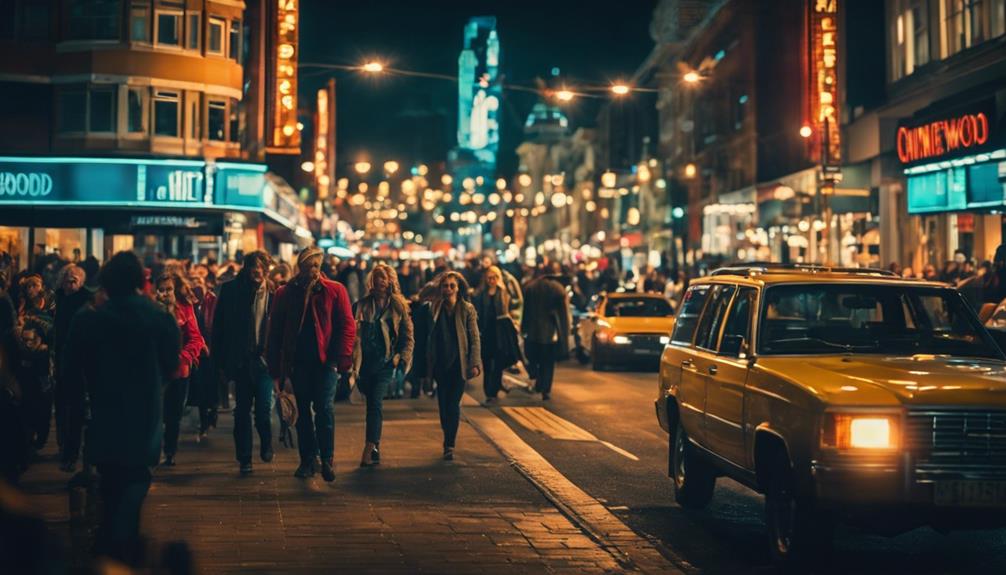
Urban, Hyperrealistic, Emotional
On a deeper level, Richard Estes' hyperrealistic depictions of urban environments reveal a profound emotional power rooted in the subtleties of human interaction and the experiential nuances of modern life.
These highly detailed scenes transcend the conventions of photorealism, surpassing mere technical skill and instead capturing the intricacies of human emotion and connection.
Estes' artworks confront the viewer with the mundane, yet riveting, moments of urban existence, involving the observer within the visual narrative.
The evocative power of Estes' work can be attributed to his masterful portrayal of light, color, and texture, which together evoke complex emotions, from nostalgia to contemplation.
Frequently Asked Questions
Why Is Complexity Important in Art?
Why Complexity Matters in Art
Complexity is crucial in art as it impacts cognitive load and influences the brain's information processing. Effective art balances visual and cognitive complexity, enhancing engagement by presenting harmonious elements within the viewer's mental capacity. Here are three key takeaways:
Balanced complexity promotes engagement and avoids overload.
Visual harmony is critical for manageable mental processing.
Stimulation enhances interest without overwhelming the viewer.
What Is the Point of Photorealistic Art?
Creating Emotional Connection with Photorealistic Art
Photorealistic art's main objective is to create an emotional connection with the viewer by precisely replicating reality.
Key takeaways:
Emotional connection: Photorealistic art evokes deep responses through attention to details and textures.
Precision: Replicating reality with precision involves precise attention to details and textures.
Intimacy: Photorealistic art transcends realism, seeking an intimate response from the viewer.
Why Is Realistic Art Important?
Realistic Art's Significance
Realistic art offers a profound reflection of our shared realities, fostering empathy through precise and detailed representations of life experiences, desires, and emotions.
Artistic Intent: Realistic art demands meticulous skill in capturing precise details and emotions, evoking creative problem-solving and artistic intent, making it a significant art form that deserves appreciation.
Mastering Technique: It provides a starting point for artists to develop skills, which can then be employed in various styles, including abstract art, and is essential for artistic excellence.
Unifying Experience: Realistic art transcends time and space, allowing audiences to connect with shared human experiences and emotions on a deeper level, making it a vital cultural reflection.
What Is the Importance of Photorealism in Modern Art?
The Role of Photorealism in Modern Art
Photorealism is a crucial art movement that has profoundly impacted modern art by challenging traditional representation and pushing the boundaries of visual storytelling.
Challenging Representation: By rendering minutiae with precision, photorealists challenge traditional notions of representation and create new ways of storytelling.
Visual Communication: Photorealism creates new ways of visual communication, making the captured image more detailed and realistic.
Artistic Innovation: Photorealism plays a significant role in artistic innovation, encouraging artists to use new techniques and tools to capture the world around them.