

Deep Learning Image Generation Tools Simplified
Deep Learning Image Models
AI image generation tools use Artificial Neural Networks trained on vast datasets to transform textual descriptions into highly accurate images.
This is achieved by leveraging techniques such as Diffusion Models and Generative Adversarial Networks. These models recognize patterns and relationships by processing extensive image-text pairs, ensuring precise refinement.
Understanding these tools allows access to the future of visual creation.
Text-to-Image Conversion
The process begins with Natural Language Processing models, which translate textual data into numerical representations that capture semantic meaning and context.
This numerical format acts as a navigational map for the AI image generator. It guides the AI on the components to incorporate into the image and how they should interact.
This results in images that accurately reflect the original text prompt.
Key Takeaways
- Deep Learning: Neural networks trained on massive datasets to recognize image patterns.
- Creating Images: Diffusion models, GANs, and neural style transfer for tailored results.
- Text-to-Image: Trained on vast image-text pairs to create visuals matching descriptions.
The text has been simplified and rewritten to meet the specified stylistic requirements.
How Deep Learning Works
Artificial neural networks are the fundamental component of crowd-sourced image generation tools. They mimic the logic of the human brain in recognizing patterns and connections within images.
These networks are trained on massive datasets of millions or billions of image-text pairs, allowing them to learn the semantic meaning of prompts and generate images accordingly. Each node in the network processes a small piece of image data, gradually refining the image to match the input prompt.
Artificial neural networks can transform a simple text description into a highly realistic image, even if the original images used in training are not visible in the generated image.
The key aspects of deep learning that enable this functionality are the ability to recognize patterns and relationships, the capacity to learn from a large dataset, and the computational power to process complex algorithms.
AI Image Generation Tools
AI image generation tools have made significant progress in recent years.
Deep learning algorithms are the backbone of these systems, allowing them to translate text into stunning visuals. Neural networks trained on extensive datasets can generate high-quality images tailored to specific styles, colors, or compositions.
Techniques such as diffusion models, Generative Adversarial Networks (GANs), and Natural Language Processing (NLP) are employed to create these images.
These tools have robust capabilities and offer applications in various fields, including entertainment, marketing, fashion, and healthcare. Their use can range from storytelling and design visualization to education and more.
The potential for digital expression has never been greater, and concerns around bias, copyright infringement, and artist compensation must be addressed as these tools evolve.
Diverse tools like DALL-E 2 and Midjourney V5 highlight different strengths and weaknesses. They can be leveraged to enhance workflows and unlock new avenues of creativity.
Text-to-Image Process Explained
Text-to-image tools are remarkable for their ability to translate textual descriptions into stunning visuals, harnessing tech that grasps language nuances profoundly.
This natural language processing (NLP) capability allows these tools to identify crucial components like objects, scenes, and emotions within the input text.
To generate images effectively, these tools train on vast amounts of image-text pairs, recognizing patterns and relationships.
Because they are trained on extensive datasets of text-image pairs, these generators can capture the essence of the input text through iterative refinement.
A loss function measures the difference between the generated image and the desired output, guiding the refinement process towards a highly realistic and contextually relevant image.
This precision in the generation process results in remarkable capabilities evident in tools like DALL-E 2, Midjourney, and Stable Diffusion, successfully producing high-quality images from text prompts.
Understanding Neural Networks
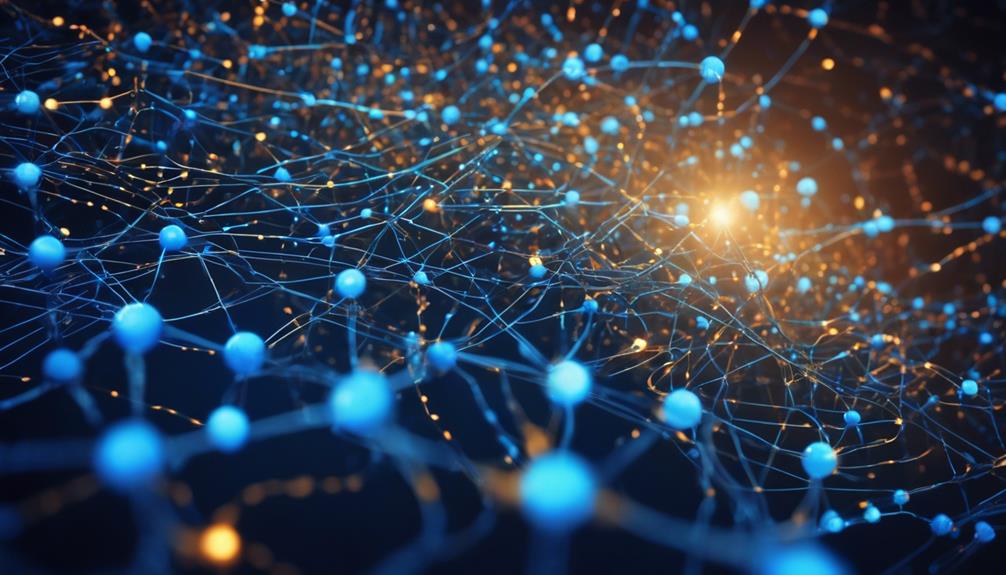
Neural networks, foundational components of deep learning, are intricate structures comprising interconnected nodes or neurons that efficiently process and transmit information, thereby allowing AI image generators to learn from massive datasets and produce remarkably realistic images.
Neural networks operate by processing data in multiple layers, starting with an input layer, followed by one or more hidden layers, and finally an output layer, which permits the learning of complex patterns and relationships within the data.
The architecture of neural networks is critical, as the number of hidden layers and neurons can substantially impact performance.
Deeper networks are capable of learning more complex and abstract representations but also increase the risk of overfitting.
Activation functions such as sigmoid, ReLU, and tanh are employed to introduce non-linearity into these networks, enabling the learning and representation of complex relationships within the data.
Understanding the intricacies of these networks is essential for leveraging their power in image generation tools, which require neural networks to learn from vast datasets and generate realistic images efficiently.
Birth of Style Transfer
Style Transfer
Harnessing Deep Learning for Artistic Fusion
Style transfer, a landmark technique in AI image generation, has opened up new artistic possibilities by merging the styles of disparate images using deep learning algorithms.
This technique has been made possible through advancements in deep neural networks, such as generative adversarial networks (GANs) and neural style transfer algorithms.
Neural Style Transfer: The Key to Artistic Fusion
In neural style transfer, the style of a reference image is transferred to a target content image by manipulating the statistics of the image's feature activations.
This algorithm ensures that the output image preserves the semantic features of the content image while adopting the visual style characteristics of the reference image.
For instance, it can transform a black-and-white image into color or apply renowned artistic styles like those of Van Gogh and Picasso.
Real-World Implications and Future Developments
The birth of style transfer techniques has far-reaching implications, from entertainment and marketing to healthcare, as it can be used to create engaging and realistic content.
It has set the stage for more sophisticated techniques being developed in the field of AI image generation.
Generative Adversarial Networks
Generative Adversarial Networks
Generative Adversarial Networks enhance the capabilities of deep learning by refining and diversifying AI image generation.
Consisting of a generator that creates images and a discriminator that evaluates generated images, GANs foster an adversarial training process to improve the generator's performance.
Trained on large image datasets, GANs learn intricate patterns and structures, enabling them to generate realistic images with remarkable accuracy.
The generator processes a random noise vector to produce images, while the discriminator evaluates an image, predicting the probability that it is real.
This process has led to applications in image generation, data augmentation, and style transfer, achieving state-of-the-art results.
GANs come in two main types: conditional, which generates images based on specific conditions, and unconditional, where no specific attribute is defined.
These networks underscore significant potential in AI-driven image generation tools.
Generating Images and Data Augmentation
In machine learning, GANs are used for data augmentation by creating synthetic images that mimic real-world data.
This approach expands the size and diversity of training datasets, leading to improved model performance and robustness.
Power of Variational Autoencoders
Variational Autoencoders represent a powerful class of deep learning models that have revolutionized image generation capabilities by leveraging probabilistic methods to learn intricate distributions and generate high-quality images.
These models consist of two neural networks: an encoder that maps the input image to a lower-dimensional latent space and a decoder that maps the latent space back to the original image.
The key advantage of VAEs lies in their ability to learn a continuous and structured representation of the input data, enabling efficient and flexible image generation, manipulation, and editing.
VAEs have been extensively used in various image generation tasks including image-to-image translation, image synthesis, and image editing.
Unraveling Deep Dream Abilities
Deep Dream Capabilities
Deep Dream, a pioneering AI image generator, leverages a convolutional neural network to generate surreal, dream-like visuals. This innovative tool utilizes a trained CNN to enhance and exaggerate features within an image, producing fantastical and often unsettling visuals that blur the line between reality and fantasy.
Surreal Visuals
The algorithm's capabilities result in surreal visuals that are often fantastical and unsettling. By amplifying features within an image, Deep Dream produces visuals that blur the line between reality and fantasy.
Artistic Expression
The algorithm, trained on a large dataset of images, enables the recognition and amplification of patterns, shapes, and textures. Many artists use this tool to create stunning visuals, pushing the boundaries of creativity.
Creative Implications
This technology raises important questions about the role of AI in creative processes and the potential for machines to augment or even surpass human creativity. Deep Dream has become a central topic in the discussion of AI-generated art and its implications for the future of creative endeavors.
Best Practices for AI Use
Integration Best Practices for AI in Creative Processes
To ensure seamless integration without compromising artistic identity, establishing clear objectives, judicious tool selection, and careful iteration and collaboration are essential when leveraging AI image generators.
Key considerations to achieve peak results and ethical use include:
Clearly Define Objectives
Ensure the desired output is well-defined, certifying that AI image generators are used appropriately.
Choose the Right Tool
Select tools like DALL-E, Stable Diffusion, and Deep Dream based on their strengths in various areas, such as customization and control. This guarantees the right AI tool supports your creative vision.
Iterate and Collaborate
Iterate on prompts and collaborate with other creatives to refine results and preserve artistic integrity.
Ethical Considerations
Certify that AI tools are used responsibly, avoiding potential biases and respecting copyright laws.
High-Quality Training Data
Certify high-quality training data to guarantee accurate and reliable outputs.
Frequently Asked Questions
Is There a Free Version of Dall-E?
Yes, there is a free version of Dall-E, Dall-E Mini, which offers lower-resolution images for non-commercial use, supports community involvement, and allows enhancements with available upscaling tools.
Can Chatgpt Generate Images?
- ChatGPT integrates DALL-E 3 for image generation through text prompts.
- DALL-E 3 provides detailed image creation, addressing language barriers.
- Artistic expression is supported with high-quality images.
What Is Image Generator in Deep Learning?
Deep Learning Image Generators
Deep learning image generators use generative models to create visual representations from textual inputs.
Key Takeaways:
- Deep learning models synthesize images from text prompts.
- Neural networks transform text into visual representations.
- Computer vision techniques enhance image quality.
Is There a Free AI Image Generator?
Yes, free AI image generators are available for image creation, offering unlimited design options with zero-cost graphics. Deep Dream Generator and Let's Enhance enable full customization and high-quality AI artwork generation.
- Deep Dream Generator: Free AI art and photo maker.
- Let's Enhance: AI to enhance, upscale, and generate pictures.
- StarryAI: Free AI design generator for effortless image creation.
